

Accelsius is Building for a Two-Phase Future
Funding Supports New Products, 300 MW Customer Project, and Coolant Fluid Research

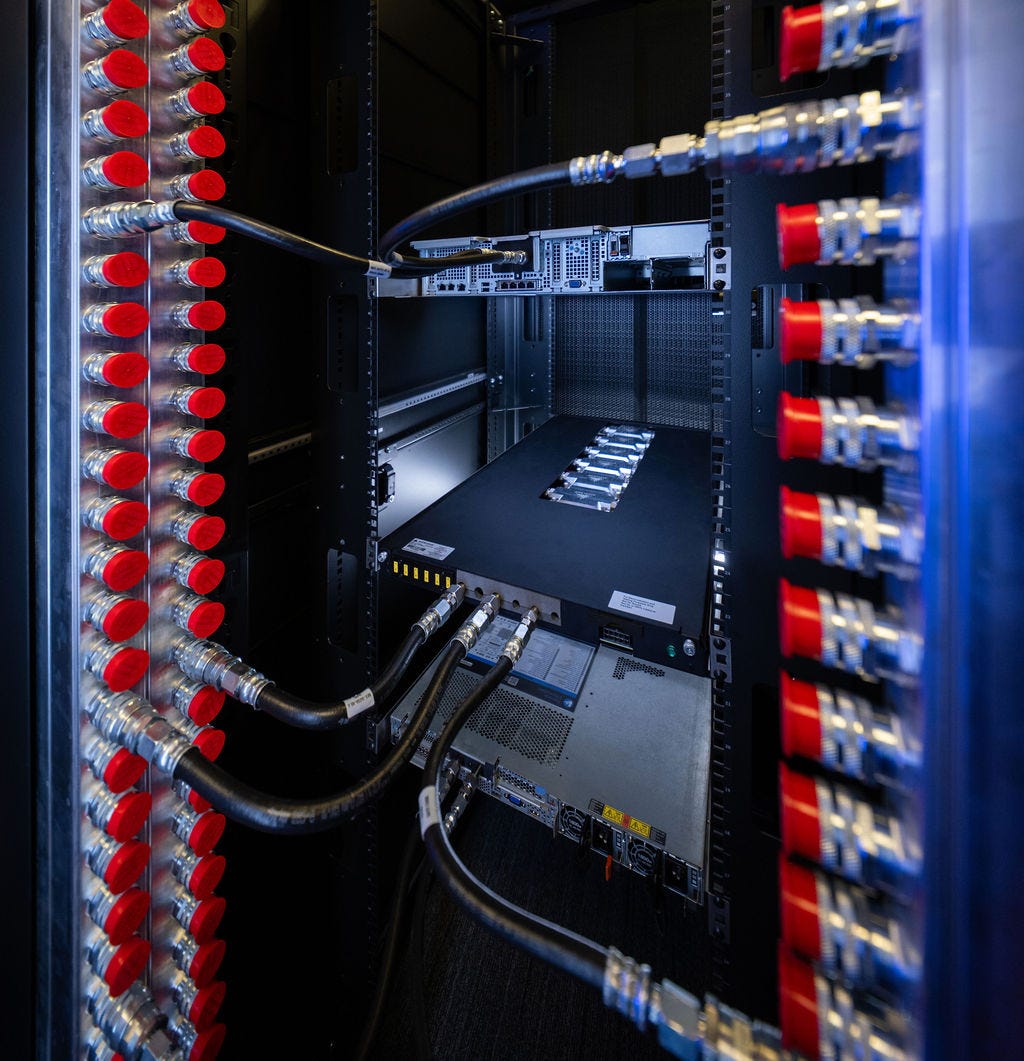
Powerful AI hardware is pushing broad adoption of direct-to-chip liquid cooling. With growing expectations of 1 megawatt racks, some data center players are preparing for two-phase cooling, the next likely evolution of the market.
One of the leading players targeting this opportunity is Accelsius, which started 2026 with a $65 million Series B funding led by Johnson Controls, with participation by Legrand. With fresh capital and experienced data center vendors as partners, Accelsius is positioning itself to seize the opportunity in two-phase cooling.
That effort kicked off in earnest last month at Data Center World, as it launched the NeuCool IR150, a server rack with an integrated coolant distribution unit (CDU) to support densities of up to 150 kW in a 42-unit design. Accelsius says the IR150 offers a “plug-and-play” system that makes two-phase liquid cooling available to enterprises and hyperscalers.
There have been other key developments as well:
Late last year Accelsius announced an agreement to deploy its NeuCool two-phase technology at a new 300-megawatt data center campus being built by DarkNX in Ontario, Canada.
At the recent OCP EMEA conference, the Accelsius team and SK Innovation shared promising research about a new coolant fluid with the potential to address key efficiency and sustainability challenges for two-phase cooling.
Accelsius also continues to research a “universal cold plate” that can support both single-phase and two-phase cooling, which could simplify a transition between cooling technologies.
The business momentum for Accelsius comes as the data center sector is preparing for NVIDIA GPU platforms that are driving adoption of high-density racks.
“Everything is becoming liquid cooled,” said Accelsius CEO Josh Claman. “We think this means the market is coming to our sweet spot.”
The Liquid Cooling Equation
For many years, IT server heat has been managed using cool air. But adoption of liquid cooling is accelerating as NVIDIA and other vendors release more powerful AI hardware. Research by Omdia projects that liquid cooling will become mainstream in the next two years, and dominate new deployments by 2030.
Direct-to-chip liquid cooling (DLC) via a cold plate is currently the leading implementation. Many analysts believe that as rack densities continue to rise, the next step in managing extreme density will be two-phase cooling, delivered at the chip.
Two-phase direct-to-chip liquid cooling uses a dielectric fluid that changes from liquid to vapor upon contacting hot components like CPUs or GPUs. The vapor then condenses back to liquid in a heat exchanger, completing a closed loop. This approach efficiently removes high heat loads directly at the source, using less coolant volume and achieving lower thermal resistance than single-phase systems.
Here’s a look at how Accelsius technology works, from a demo at Data Center World 2025:
Early implementations of two-phase cooling used immersion, where entire servers are submerged in a cooling bath. Immersion has been widely used in cryptocurrency mining, but is less common in traditional data center environments, partly due to concerns around server maintenance.
By comparison, a two-phase direct-to-chip design targets only the hottest components. This allows for denser server configurations, easier component access, and better integration with existing rack infrastructure. It also avoids issues like fluid contamination or equipment compatibility that are sometimes seen in full immersion.
A Liquid Cooling Transition?
Most analysts foresee big gains for liquid cooling in the next five years as high-density racks become the standard for a broader range of computing tasks, especially AI.
“The two-phase direct or two-phase immersion market is small now,” said Vlad Galabov, the Senior Research Director for Enterprise Infrastructure at Omdia. “In 2030, it becomes a multi-billion dollar market.”
