

Are Data Centers Ready for the Future of Heat?
New Studies Find Increased Climate Risk in Cooling, Supply Chain and Site Selection

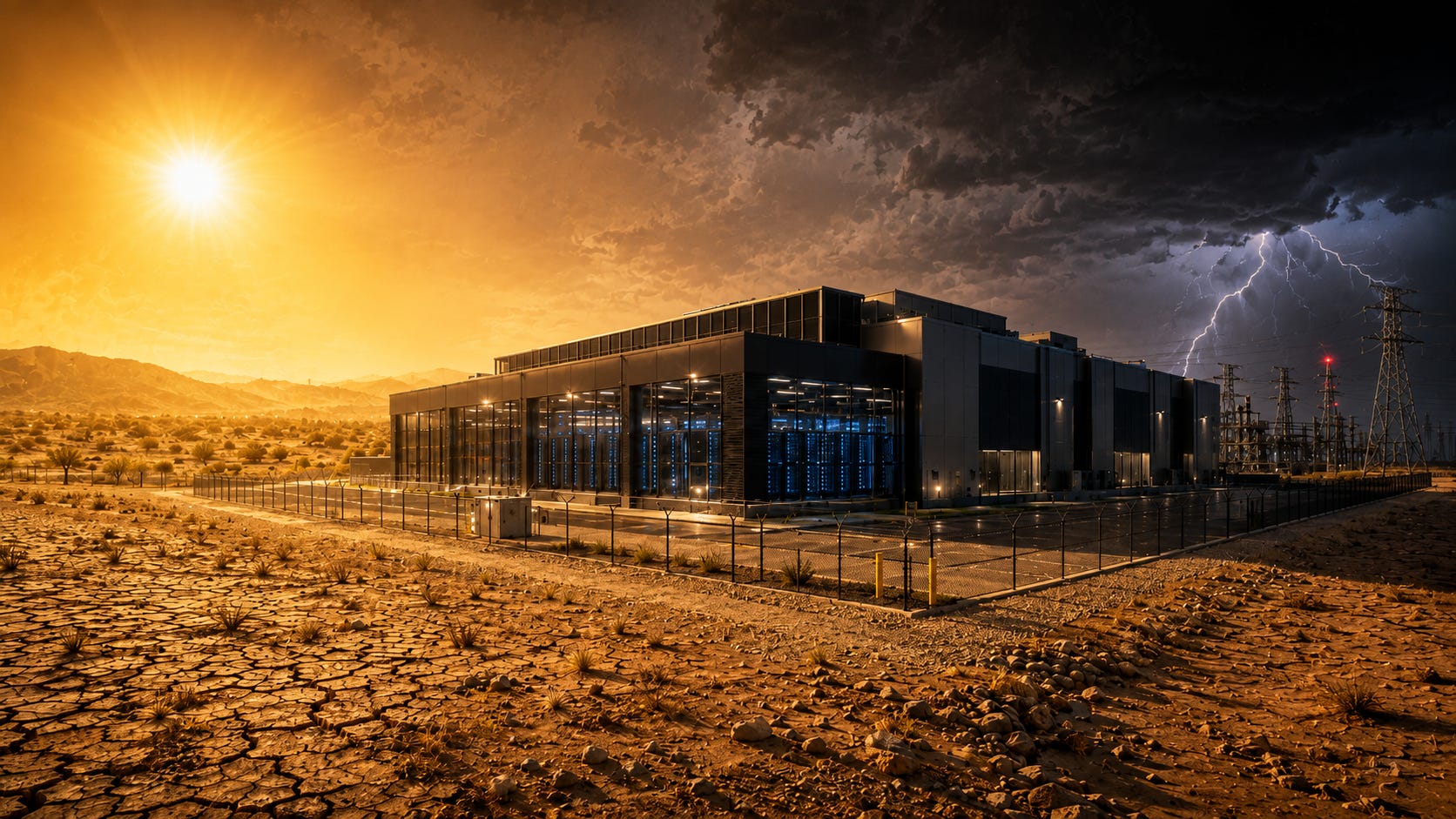
As a heat wave takes hold across much of the U.S., the limits and longevity of data center design are coming under fresh scrutiny, as new research finds that climate change is unsettling the assumptions guiding where and how data centers are built.
.
The research from Google, Schneider Electric, and First Street arrives as successive heat waves test power grids and cooling infrastructure worldwide. Mounting climate stress is a test for data center operators, but could also reshape the risk equation for insurers, lenders, and investors, with one estimate placing the global climate risk facing the sector at $388 billion.
The three reports take different cuts at the same question: how much climate risk do data centers face, and what can be done about it?
Google has disclosed Prometheus, a forecasting framework already running at 30 production sites, which finds that keeping pace with warming will require adding cooling capacity: 11% on average, and up to 48% at the most exposed sites.
Risk modeling specialist First Street maps exposure across 97 global markets, finding that 54% of data center capacity already runs under chronic heat or water stress and 79% sits in markets with elevated flood, wind, or wildfire risk.
Schneider Electric’s Research Institute, in a paper titled The Repricing of Compute, advances the $388 billion risk estimate and warns that the largest single risk channel will be found in supply chains.
Climate stress is likely to manifest as higher operating costs, more frequent outages, rising insurance premiums, and a slow erosion of the predictable cash flows lenders and investors underwrite against.
First Street and Schneider converge on the same argument: the risk is real, unevenly distributed, and underpriced. Markets with identical power cost and connectivity can carry very different climate exposure. Financial markets have largely not adjusted to these climate risk factors, suggesting a future “repricing” as insurers, lenders, and appraisers fold physical risk into premiums, debt terms, and valuations.
The good news: climate adaptation can deliver a strong payback. Schneider finds that structured investment cuts exposure by roughly a third, with positive returns under every scenario tested, and that each year of delay turns a design choice into an expensive retrofit.
Heat Waves Highlight Risk Factors
A record heat wave broke over Europe last week, and a second is bearing down on the United States this week.
Last week a heat dome settled over Western Europe, pushing temperatures past 40°C (104 F) across France, Spain, and Italy and driving the UK to a fresh June record near 37°C.
Today a sprawling heat dome is forecast to bake the central and eastern U.S. through the July 4 holiday, exposing roughly 200 million people to highs between 95 and 105, with heat indices reaching 110 and beyond.
Most modern data centers are engineered to operate through these types of conditions. But as heat waves become more intense, they have brought high-profile failures, including several during historic heat waves in 2022.
In July 2022, multiple cooling systems at a Google facility in London failed as temperatures hit a record 40C/104F, resulting in a 35-hour outage for some Google Cloud customers. The incident report noted the “extraordinarily high outside temperatures.”
In September 2022 a Sacramento data center for Twitter went offline as Temperatures reached 113 degrees on the day of the outage.
This week’s heat wave will be a test for regional power grids. The PJM Interconnection predicts that electricity demand across its 13-state territory will reach an all-time record of 166 GW Thursday (July 2), exceeding a record set in 2006.
With that context, here’s a look at the new studies on data centers and climate.
Google: Designing for a Warmer Future
Google’s Prometheus framework answers a simple question: how much cooling will a data center need over its lifetime, given a climate that keeps evolving?
After deploying the framework across 30 production sites, Google found that maintaining today’s reliability will require 11% more cooling capacity on average, and up to 48% at the least-prepared sites. Roughly 12% of locations already exceed their design temperatures often enough to warrant near-term upgrades, and 30% lack the deferrable workloads they would need to shed load during a heat emergency.
