

Data Centers and Virtual Power Plants: Google’s New Grid Strategy
Hyperscaler Working With Voltus to Deploy 100 Megawatts of Power on the PJM Grid

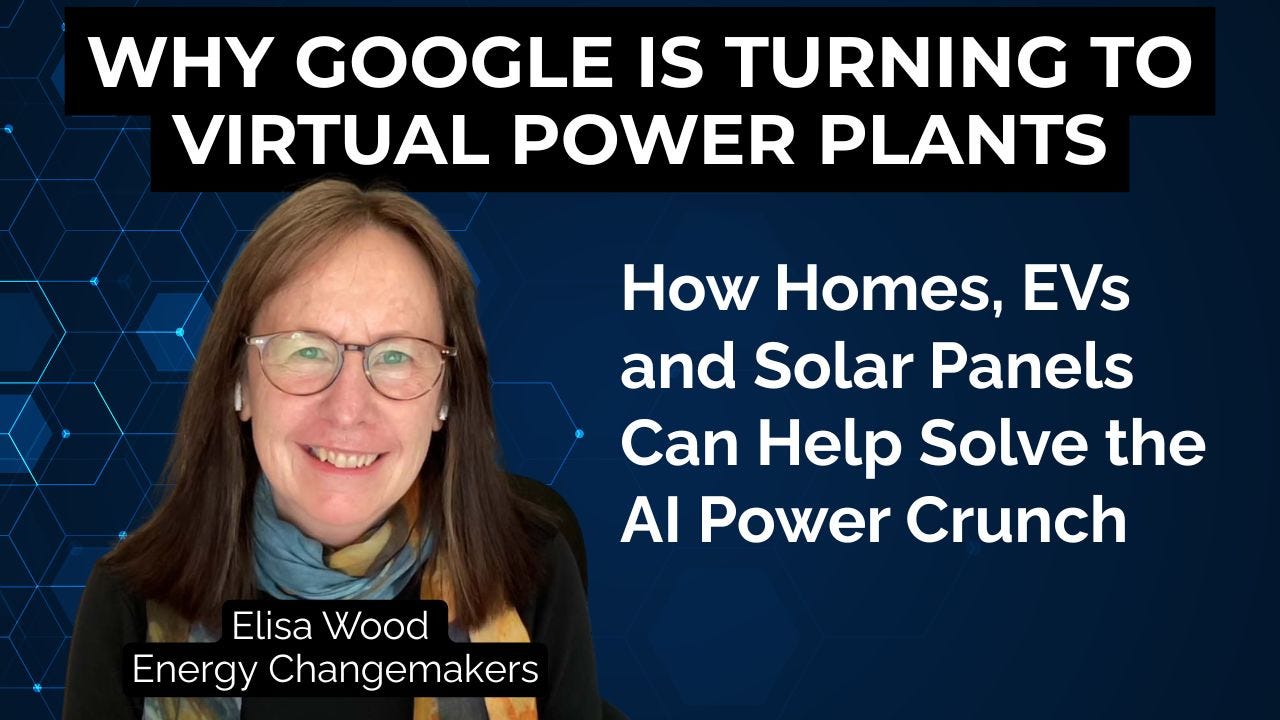
Can electric vehicles, solar panels and smart thermostats in homes help free up more grid power for data centers?
The concept known as a virtual power plant or VPP. It’s a collection of small energy sources that are brought together to create a large energy asset, which can be managed to help support the power grid in moments of high usage. The owners of homes and vehicles get paid for the energy they share back to the grid.
This concept just got a huge vote of confidence from Google, which has signed a “Bring Your Own Capacity” deal with VPP specialist Voltus designed to enable 100 megawatts of new capacity on the PJM Interconnection, which serves 67 million customers in the Eastern half of the country.
To learn more, I spoke with Elisa Wood from Energy Changemakers, an expert in distributed energy. On the Data Center Richness podcast, Elisa explains virtual power plants, how they work, and the recent deal between VPP provider Voltus Energy and Google.
Here's my conversation with Elisa Wood:
This Data Center Download provides key insights from the Data Center Richness podcast with Elisa Wood, exploring how Virtual Power Plants (VPPs) work, why they are a win for local communities, and how this deal offers a new blueprint for the future of clean energy.
📌 Key Takeaways
Pioneering Partnership: Google’s agreement with Voltus is the first-ever VPP deal signed by a data center operator.
Unlocking Capacity: The “bring your own capacity” deal will inject 100 megawatts (MW) of flexible capacity into a heavily strained regional grid.
Offsetting over Injecting: VPPs do not directly power data centers; instead, they reduce community demand to ease overall grid stress.
Community Goodwill: By paying homeowners for their shared energy, tech companies can actively combat rising public backlash against data center developments.
What is a Virtual Power Plant (VPP)?
A Virtual Power Plant is a network of decentralized, small-scale energy resources - such as residential solar panels, electric vehicles (EVs), smart thermostats, and heat pumps - that are aggregated into a single, cloud-managed asset. During peak demand windows, a VPP provider can coordinate these resources to scale back usage or feed electricity back into the system, functioning exactly like a traditional power plant from the grid’s perspective.
The Google-Voltus Agreement
The landmark deal between Google and Voltus is structured as a “bring your own capacity” agreement on the PJM Interconnection, the regional transmission organization serving 67 million people in the eastern United States. This region is currently the epicenter of a massive data center influx, leading to severe capacity constraints, grid interconnection backlogs, and soaring power prices.
💡 Key Insight: A common misconception is that a VPP directly injects electricity into a tech company’s physical facility. In reality, it acts as a demand offset. By easing pressure on the local grid during critical hours, it reduces the overall impact when a large consumer like Google draws its required power.
Flipping the Data Center Narrative
Public friction surrounding data center development has escalated significantly. Recent polling from Gallup and Heatmap shows that roughly 70% to 71% of Americans now oppose data centers in their local communities - a resistance level higher than that faced by nuclear power at its peak opposition in the 1960s.
Alleviating Rate Payer Anxieties
Data shows that local opposition is intensely focused on the fear of rising electric utility rates. When massive facilities gobble up regional power supply, everyday consumers worry they will be stuck footing the bill for infrastructure upgrades. VPP models address this head-on by turning community residents into paid participants rather than displaced bystanders.
Monetizing Household Energy
While Voltus has not yet released the specific onboarding logistics for this project, a standard VPP provides direct rewards to the end consumer. Homeowners with qualifying distributed energy resources (DERs) receive a notification to join the program. When grid demand spikes and the VPP is activated, participants are compensated via utility bill credits or direct financial payouts.
Alternative Approaches: Organizations like Rewiring America are exploring an alternative “tangible exchange” model where a data center operator directly buys, subsidizes, or provides hardware credits for solar panels, batteries, or EVs for community members.
A New Model for the Energy Sector
Google has long maintained an “all of the above” approach to energy innovation, actively funding portfolios that span advanced geothermal, small modular nuclear reactors, power purchase agreements (PPAs), and microgrids. While a 100 MW deal is a drop in the bucket compared to the total electricity hyperscalers consume, its value as a proof-of-concept is massive.
The Ripple Effect for Distributed Energy
Historically, many companies have avoided being the first to test unproven energy frameworks. Because a major player like Google has validated this approach, it reduces the reputational risk and establishes a repeatable blueprint. VPP developers now have a proven marketing and social model to get their foot in the door with other major industrial energy consumers.
Taking Action
For Homeowners: Check with your local utility provider or independent DER aggregators to see if your smart thermostat, solar storage, or EV charger qualifies for an active regional VPP program.
For Energy Managers: Evaluate how distributed energy assets and flexible demand response strategies can be integrated into corporate sustainability portfolios to help manage localized grid congestion.
This text companion accompanies the video Why Google is Embracing Virtual Power Plants featuring Elisa Wood, founder of Energy Changemakers. Watch on our YouTube channel for the full conversation and additional context.