

Lessons From a Data Center Pioneer
Google Alum Joe Kava on Building Data Centers Responsibly at Gigawatt Scale

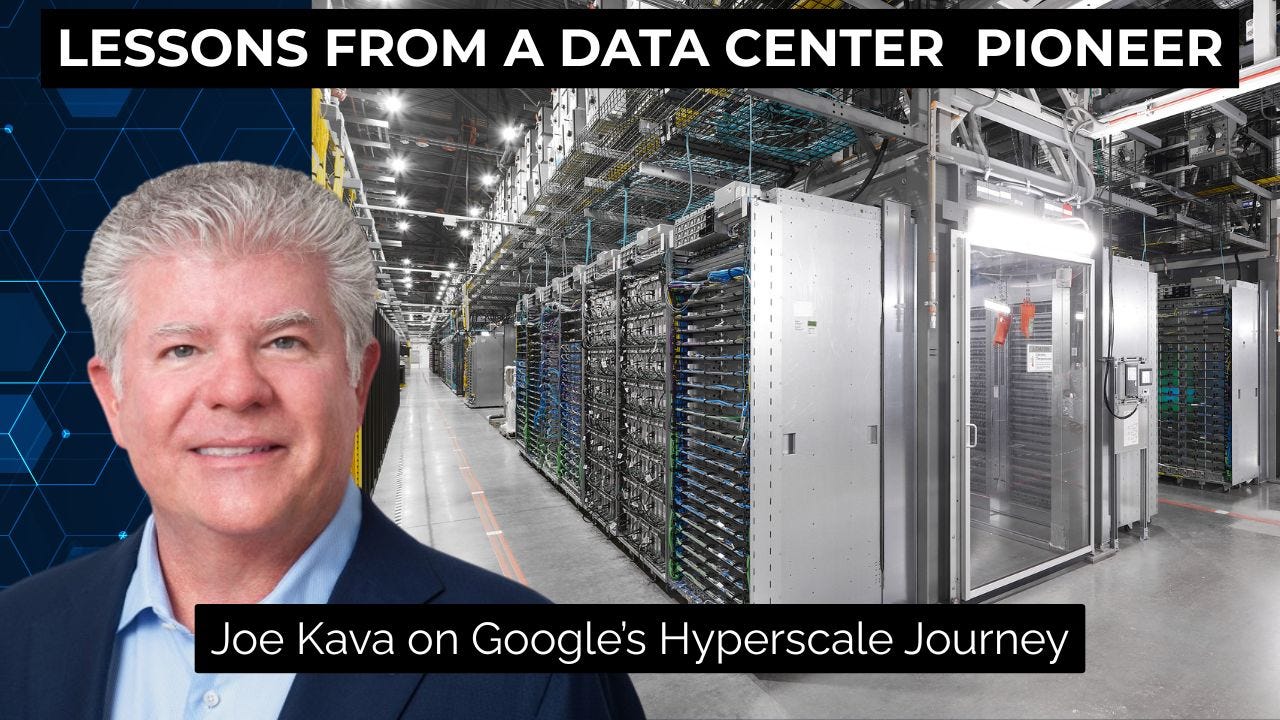
What’s it like to work on the front lines of hyperscale development? And how can the lessons and innovation from that process inform how to build smarter for the future?
On the Data Center Richness podcast, I sat down with Joe Kava, who led the Google data center team through an amazing phase of growth, both for the company and the data center industry.
Joe retired from Google in 2025, and at the Data Center World 2026 conference, he was honored with the Lifetime Achievement Award. In our conversation, Joe shares his thoughts on his journey at Google, and what’s next for the data center sector - including thoughts on building responsibly amid public pushback on AI growth.
Here's my conversation with Joe Kava:
Here’s an excerpt from the Data Center Richness podcast with Joe Kava, where we discuss the challenges in building at gigawatt scale, and whether the data center sector can adapt to the wave of community resistance to AI development.
Rich Miller, Data Center Richness: At Data Center World you talked about all the many challenges before the industry, and that there are many things left to do, including how we think about energy use and the grid. You’ve retired from Google, but there’s so much going on in this industry. What do you see as the big tasks before us, and how do we go about addressing them?
Joe Kava: Certainly the focus on massive buildouts to accommodate the needs of artificial intelligence is unlike anything I’ve seen in my career. You can read almost weekly about some new gigawatt-scale campus that is being planned or developed. At the same time, we’ve never been in a position where the grids around the world are just incapable of handling these types of huge new load factors.
The US grid wasn’t ever designed to accommodate gigawatt point loads. And even if the generation capacity is there, the transmission capacity and the diversity and the substation transformer capacity is just not there. So what’s happening is that many of the large-scale hyperscale companies and developers are doing islanded behind-the-meter self-generation plants, as evidenced by the huge success of companies like VoltaGrid (which makes portable generator for on-site energy) and the backlog that they have for their business.
But I think that we also have to be careful and responsible about how we do it. I’m not saying that companies aren’t being responsible, but many of the world’s largest companies made public commitments to being 100% clean energy by 2030 or the early 2030s. That was done with the modeling of what the load growth looked like back when that commitment was made, and they never could have anticipated the steep increase in the load growth that’s happening because of the AI race.
And as such, the gap between the amount of carbon-free renewable energy projects that are available versus the load growth is getting wider in some cases. So while I think that companies are still committed to those objectives and commitments, I think the timing likely is going to have to push.
We’ve seen a lot of solar and wind projects getting cancelled, and not just simply because of the government subsidies and incentives, but frankly also public opinion and public policy. It’s not really in favor of that. So the competition for the (renewable energy) projects that are available is greater than I’ve ever seen.
People are getting very creative. Now it’s pretty common to have conversations in the industry about the timeline and reality of small modular reactors, and the timeline and possible reality of fusion reactors. And when can we plan on that? And now space-based data center networks. These are things that, even just a few years ago, really weren’t in your day-to-day conversations.
Community Concerns About Data Centers
Joe Kava: I don’t remember another period of time when we had the headwinds from public pushback on data centers in the communities. And it’s not just “not in my backyard” type of mentality, but it’s “not anywhere.” A lot of the pushback is “we just don’t want anything developed in the open spaces in the country.”
In some ways it’s just trying to preserve a way of life from generations ago, so this is real. Unfortunately, there’s also been some developers, in my opinion, that are not going about it correctly, and they’re giving a bad reputation to the industry as a whole.
And then couple that with the fact that the American public reads headlines. Even if an article is well researched and very balanced and written very well, the headline might be designed to attract attention. And oftentimes people don’t take the time to read the entire article.
And so people believe what they hear, which is often just the headline. And once someone has formed an opinion about something, when you’re the developer it’s really hard for them to believe you. They think that you’re just trying to tell them whatever is necessary to get the project greenlit. It’s probably the most difficult public opinion environment that I’ve ever seen for this industry.
Rich Miller, Data Center Richness: I’ve been tracking this issue for a long time, and lots of data center folks are are really frustrated with the way the industry is perceived and how communities respond to data centers. You mentioned some of the reasons for that. I think where people are kind of stuck now is wondering about the way forward.
On the one hand, everybody’s protesting data center development. But these folks are also probably still using data center services all day long in most of the things that they’re doing. So it seems there’s a disconnect there.
Do you have any thoughts on how the digital infrastructure sector can encourage people to think differently about the requirement for data centers - regardless of how one might feel about AI, because I think that’s in the mix?
Joe Kava: I think that we’re going to have to really come together as an industry, and address it from a couple of different angles. First and foremost, I think we’re probably the largest contributor to the global GDP that doesn’t have an industry-wide advocacy group working on our behalf every day in Washington, helping to educate our elected officials and the administration on the necessity.
We used to do pieces on “a day in the life of data centers.” Maybe we should do a piece on “a day in the life without data centers.”
I think people would really benefit from understanding all of the things that we take for granted every day that are enabled on the backs of this digital infrastructure that we’re building, and probably all of your audience that are listening to this know that inherently. But the average person in the United States doesn’t know how electricity is generated and transmitted and gets to their house. All they know is that when they flip the light switch, the lights come on, and maybe that’s all they should know.
But right now there is so much misinformation out there about data centers, and the fear that data centers are going to consume all the electricity, and communities won’t be able to grow because there’s not going to be power for the growth of the community. Or all the water is going to be consumed and there won’t be drinking water for the communities, and all the free land is going to be gone, and we’re just going to be surrounded with nothing but these big data center buildings.
Possible Solutions
Joe Kava: And so, one, I think we need a common voice, an advocacy organization. I think the Data Center Coalition is trying, but it needs to be much, much more aggressively staffed, funded, and really with a common messaging. Because our lawmakers oftentimes are not the subject matter experts in this area, and they’re reacting to constituents that are upset about development in their communities.
And second, I think that the industry probably needs to take a different approach in determining where to build right now. It used to be you’d go out and find the land that you want, and you could almost always be guaranteed that you could get power to the land. It might just take a little bit of time or a little bit of money to do a transmission upgrade or something, but you could pretty much be assured that you could get the power there.
And then that switched to kind of a power-first approach - you want to be in this rough metro area, go and find an area on the grids that might have some excess power capacity on the transmission lines, and then find land around there. And so you switched to a power-first approach about site selection, but it’s still not really considering the other impact around the communities.
One of my colleagues that I worked with at Google for a long time, Gary Demasi, made this comment the other day and I totally agree with him. He said maybe we need to take a different approach and work with the governors and the mayors, and ask, “where do you want data centers in your state?” And maybe work with them to develop special enterprise development zones in their states, because then it’s defensible to their constituents, and they could then stand up and say, “No, we worked with the industry and we told them this is where the data center should go in this state,” rather than just kind of a shotgun approach where every company has their own approach about where they’re trying to land and expand. So really be more collaborative with the state and local governments about where the industry should be developing in your state.
Those still might not be enough, but I think that those two activities are a very, very good start. One, central advocacy, and then two, a more collaborative approach with state and local governments as to where the industry should be in the states.
This article accompanies the video “How Google Built The Future of Data Centers” featuring Joe Kava. Watch on our YouTube channel for the full conversation and additional context.