

NVIDIA DSX: Data Centers Meet the Simulation
Digital Twins and 3D Modeling are Central to the NVIDIA's Vision for AI Factories

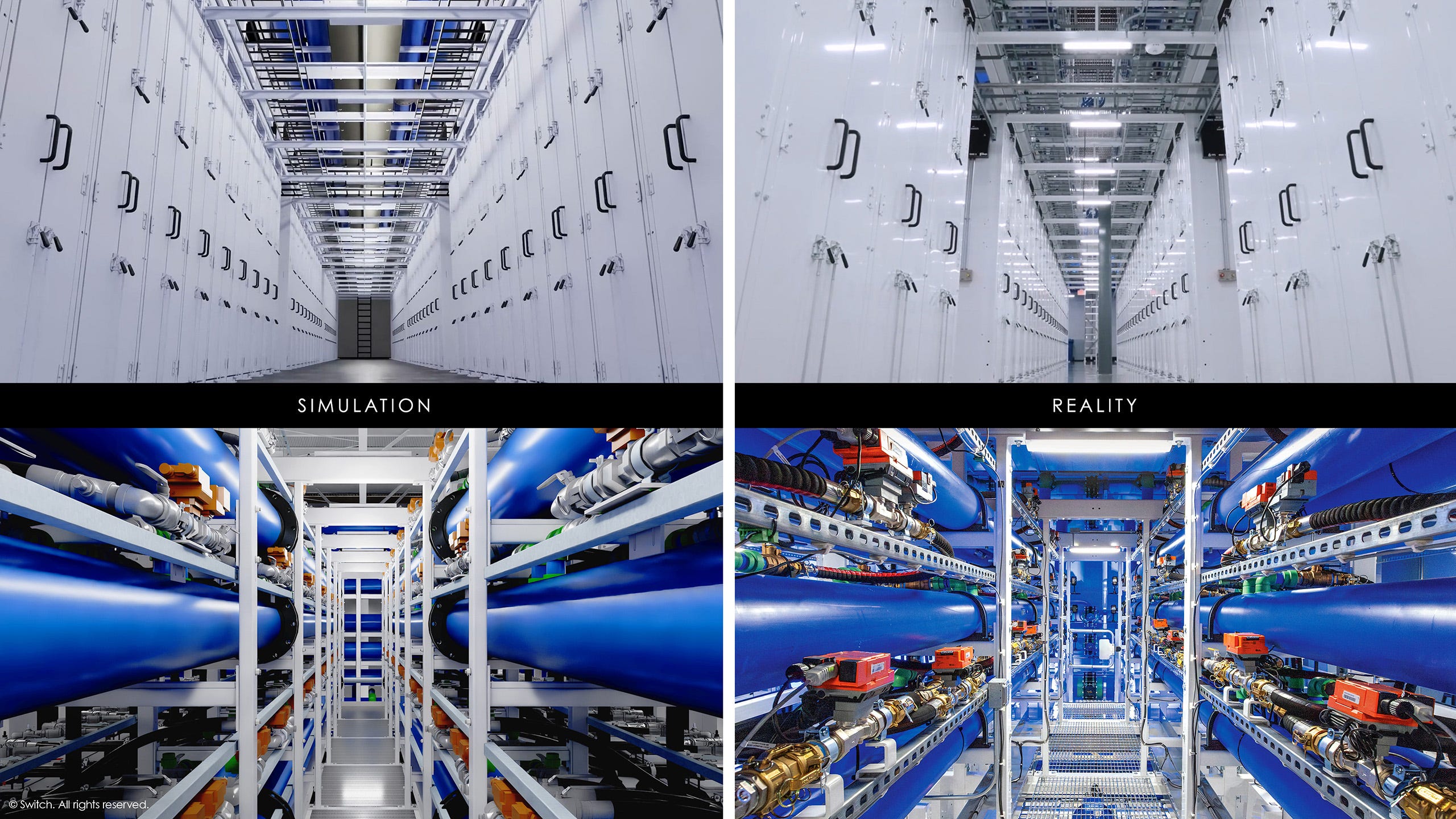
Are data center designers ready to enter the simulation?
NVIDIA is advancing the use of “digital twins” to design and operate AI data centers, using software and 3D modeling to simulate almost every detail of its new AI factories.
At the GTC conference in March, NVIDIA said its Omniverse DSX digital blueprint is now generally available, and has been updated with a reference design for its new Vera Rubin designs.
NVIDIA also announced DSX Air, a software-as-a-service platform making it easier for users to simulate their entire AI factory infrastructure in the cloud.
The DSX vision is now shifting from simulations to real-world data centers. Data center developers CoreWeave, IREN and Hut 8 have committed to using DSX technology to develop multiple gigawatts (GWs) of capacity. Earlier this month, IREN committed to build up to 5 gigawatts of DSX-ready AI infrastructure.
Meanwhile, Vertiv has created a DSX design for the Vera Rubin GPU platform using its OneCore design, and Switch has integrated DSX into its LDC EVO operating system.
Those are just the most visible examples of ecosystem support that extends to more than a dozen companies, including Cadence, Dassault Systèmes, Eaton, Jacobs, Schneider Electric, Siemens, and Trane Technologies, who are all contributing platforms, simulation-ready digital assets and software integrations.
The AI Factory Design Challenge
Software and modeling have been used for years in data center design. But building large-scale AI factories is complex, requiring precise coordination across infrastructure, power, liquid cooling, networking, software and compute.
That means coordinating products from across a vast partner ecosystem and multiple classes of equipment.
"As AI factories scale to unprecedented levels of power and density, enterprises require a converged approach to physical infrastructure that unifies power, cooling, and digital twin simulation to reduce deployment risk," said Vladimir Troy, vice president of AI Infrastructure at NVIDIA.
The Omniverse DSX platform uses digital twins to optimize AI factories from the chip to the grid, using a “co-design” approach to seamlessly orchestrate physical and digital assets.
The goal is to unify power, cooling, networking and operations in one environment to accelerate time to revenue and AI efficiency. Using NVIDIA Omniverse libraries, companies can simulate layouts, power topologies, thermal behavior and operational policies, and evaluate hardware or workload changes without disrupting production.
As we noted last fall, DSX can help address two huge challenges in AI infrastructure:
Integrating the design of the data center building with the hardware and software inside it, using AI simulation and 3D modeling to create intelligent facilities that continuously optimize for performance and energy efficiency.
Embracing modularity to future-proof AI facilities, enabling “multi-generation” data centers to support accelerated AI upgrade cycles.
How It Works
The Vera Rubin DSX reference design provides a guide for building the entire AI factory infrastructure stack, spanning compute, NVIDIA Spectrum-X Ethernet networking and storage, along with documentation for partners designing power, cooling and control systems. The goal is repeatable, scalable cluster performance optimized for maximum token output per watt of available energy.
The software stack is modular:
DSX Max-Q helps operators maximize computing output within a fixed power budget.
DSX Flex connects AI factories to grid services, enabling dynamic power management.
DSX Exchange integrates signals across compute, networking, power and cooling.
DSX Sim validates AI factories as high-fidelity digital twins before construction begins.
The Omniverse DSX Blueprint provides the framework for building those digital twins.
Using NVIDIA Omniverse libraries, OpenUSD and SimReady assets, developers can simulate equipment layouts, power topologies, thermal behavior and operational policies, then evaluate hardware or workload changes without disrupting production.
Equipment providers including Eaton, Schneider Electric, Siemens, Trane Technologies and Vertiv are providing SimReady digital models of their generators, electrical equipment and cooling systems, allowing engineering teams to validate complete designs in simulation before building in the physical world.
IREN to Deploy DSX Designs At Scale
As NVIDIA seeks to translate DSX simulations into physical AI Factories, it is turning to development partners building for its cutting-edge GPU platforms.
