

Scaling Data Center Construction for the AI Era
Industrialized Buildouts Grapple with Power, Supply Chain and Workforce Challenges

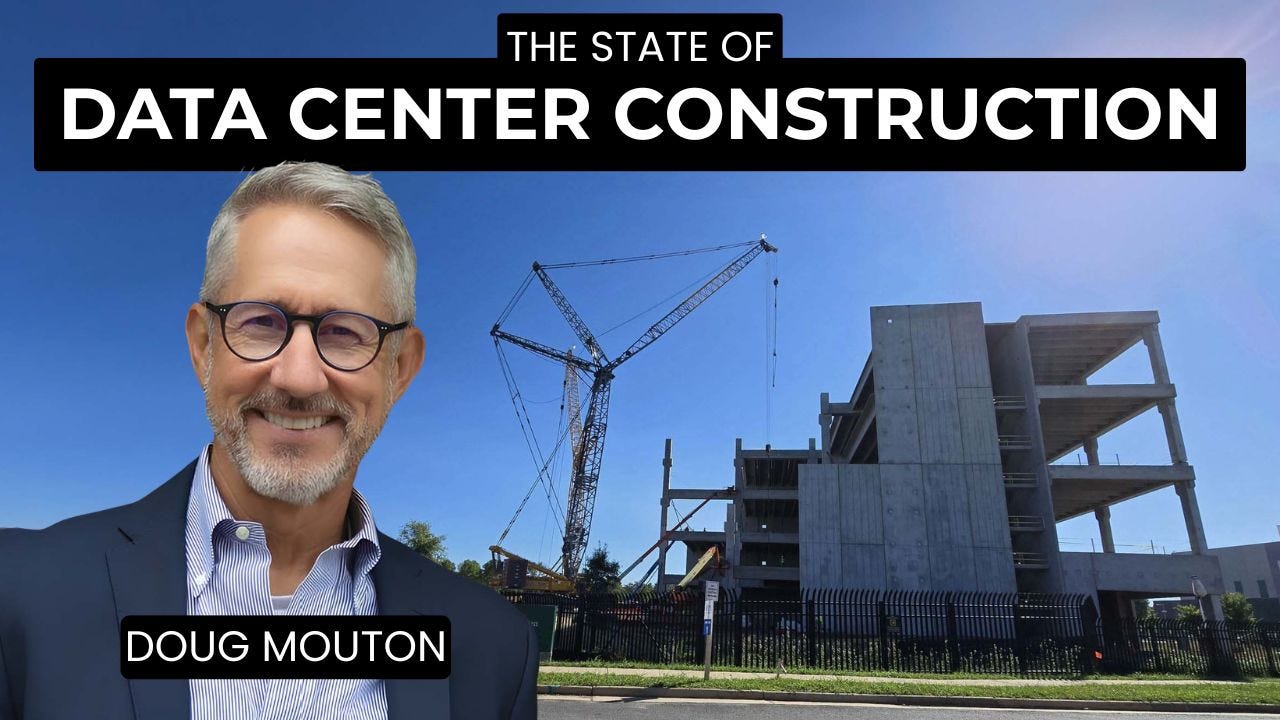
The demand for data center capacity is skyrocketing, but the reality of building at AI scale is colliding with intense supply chain, power, and workforce constraints.
As the industry races to triple capacity by 2030, executing these massive projects requires shifting away from hyper-customized designs toward industrial standardization.
So what’s the state of data center construction? To find out, I spoke with Doug Mouton, who for many years worked with construction teams building data centers for Microsoft and Meta. Doug and I discussed the complexities of building at AI scale, and the supply chain and staffing challenges faced by large campus projects.
Doug is particularly focused on worker safety on job sites. Although data center construction teams have reduced the number of safety incidents, there is more work to do, especially on mental health and wellness for a workforce facing constant pressure on delivery schedules.
Here’s my conversation with Doug Mouton:
This Data Center Download provides key insights from the Data Center Richness podcast with Doug Mouton, which breaks down the complex bottlenecks of modern data center delivery, geographic shifts, and the critical human cost of the current infrastructure boom.
📌 Key Takeaways
Prepare for massive expansion: The North American data center market is projected to see a 25% to 30% compound annual growth rate, potentially tripling capacity from 35 gigawatts to over 90 gigawatts by 2030.
Prioritize worker wellness: For every site fatality in commercial construction, there are four to five deaths by suicide, making mental health advocacy the industry’s next major frontier.
Embrace modular standardization: Overcoming grid constraints and labor shortages requires shifting to off-site fabrication for critical infrastructure like electrical rooms and mechanical skids.
Unlock stranded renewables: Deploying utility-scale batteries and long-term energy storage is essential to buffering jittery AI workloads and integrating un-networked clean energy back into the power grid.
The AI Boom and Infrastructure Delays
The data center industry is trying to build mega-campuses at a pace and scale never seen before. Over the last two decades, North America built roughly 35 gigawatts of capacity. Looking ahead toward 2030, the market is expected to surge to between 60 and 90+ gigawatts. While the drop in traditional commercial office construction has freed up some raw capital and development interest, the physical constraints on the ground are causing a growing number of projects to fall behind schedule.
The Challenge of AI-Scale Delivery
In 2014, a major cloud provider might have managed 200 megawatts of total capacity. Today, individual developers are regularly tasked with delivering a gigawatt or more within a single calendar year. This exponential scaling stresses human supply chains and places intense pressure on delivery timelines. Teams are forced to balance rapid deployment with the reality of finite skilled labor.
💡 Key Insight: The data center layer is no longer a precious, bespoke design. To meet future demand, developers must treat digital infrastructure as a predictable utility, providing the supply chain with the consistency needed to mass-produce core components.
Shifting to Off-Site and On-Site Modular Methods
To capture and maximize available labor, builders are turning to modern construction methodologies. Fabricating complex components—such as off-site electrical rooms and mechanical skids—ensures controlled quality and creates fungible assets that can be redirected to multiple sites as schedules shift. Concurrently, performing standardized on-site fabrication keeps regional trade workers continuously engaged rather than scheduling them for erratic, intermittent milestones.
The Human Cost: Safety and Mental Health on Job Sites
As construction hours multiply, tracking and improving human safety metrics becomes a matter of life and death. The data center industry has successfully utilized OSHA metrics to lower its Total Recordable Incident Rate to 0.5 or less per 100 workers. However, broader commercial construction trends still see significant site fatalities, and a deeper crisis remains hidden beneath standard safety statistics.
Addressing the Mental Health Frontier
While physical safety discipline has dramatically improved among major general contractors, mental health remains an underrecognized problem. Construction workers experience one of the highest rates of suicide in the world. The constant pressure of compressed delivery schedules creates environments of immense stress, requiring a cultural shift toward active workforce care.
The 4:1 Reality: For every single construction worker lost to an on-site physical accident, four to five are lost to suicide. Demasculinizing the job site environment and destigmatizing mental health support is an immediate necessity for delivery teams.
Capital Risks, Silicon and Shifting Geography
The financial models underpinning data center development are adapting to unprecedented technological volatility. Historically, private equity favored the low-risk profile of 20-year hyperscale leases in established markets. The rise of “neoclouds” and rapid hardware iterations has completely altered the risk composition of modern infrastructure investments.
Managing Silicon and Tenant Risk
Hardware developers like NVIDIA are introducing new graphics processing units (GPUs) on compressed, one-year cycle times, rendering previous generations functionally obsolete faster than ever before. This rapid obsolescence introduces intense silicon risk, compressing the time financial models have to prove out their returns.
Furthermore, massive gigawatt-scale deals are increasingly driven by AI research labs and specialized startups rather than traditional enterprise tenants, complicating long-term technical due diligence.
The Emergence of Growth Corridors
Due to congestion and power constraints in traditional Tier 1 markets like Northern Virginia, geography is shifting from isolated hubs to expansive corridors. Infrastructure is moving to where power is available and community resistance is low.
[Traditional Hubs] ➔ Shift to ➔ [Regional Growth Corridors]
                                   ├── I-20 Corridor (Carolinas to Phoenix)
                                   ├── Mid-Atlantic Link (West Virginia & Ohio)
                                   └── Route 80 Backbone (Iowa to Wyoming)
This distribution mimics early transcontinental railroad rights-of-way, following established fiber optic backbones while transforming rural regions into active inference and training hubs.
Power Constraints and the Future of the Grid
Power has officially replaced land as the primary constraint in data center site selection. A decade ago, energy was viewed as an abundant commodity; today, slow interconnection studies require four to seven years to complete, severely bottlenecking the market. This lag has forced developers to explore island power strategies, including building on-site generation turbines.
Interconnection and Repatriation Policy
On-site generation is ultimately a temporary bridge to computing power rather than a permanent strategy. The industry requires an updated regulatory framework akin to the 1976 Public Utility Regulatory Policies Act (PURPA) to standardize how private, islanded energy assets can eventually be integrated back into the public grid. Treating data center energy infrastructure like a public road extension allows developers to fund, build, and ultimately dedicate these power assets to local utility standards.
Unlocking Stranded Renewable Energy
Hyperscalers have invested tens of billions of dollars into scope 2 renewable energy purchase agreements, yet less than half of that contracted capacity is actually interconnected to the grid. Utilities struggle to absorb and rationalize intermittent energy profiles that depend entirely on active sunlight or wind.
The Solution: Utilizing utility-scale energy storage.
The Impact: A multi-million dollar investment in flow batteries, pump storage, or advanced chemical batteries acts as a capacitor, smoothing out the highly synchronized, fluctuating power draws typical of large AI clusters while unlocking billions in stranded clean energy.
Taking Action
To successfully navigate the constraints of the AI infrastructure boom, project delivery teams and investors should execute the following steps:
Standardize Infrastructure Layouts: Rely less on highly customized, proprietary engineering designs in favor of uniform, predictable components that supply chains can predictably fulfill.
Implement Off-Site Prefabrication: Move electrical room assemblies and mechanical piping skids to factory floors to optimize quality control and lower on-site labor requirements.
Integrate Mental Health Programs: Establish active wellness check-ins, peer-support networks, and leadership training on job sites to directly combat the construction industry’s suicide crisis.
Invest in Energy Buffering: Equip upcoming substation designs and behind-the-meter generation sites with large-scale battery storage to stabilize regional grids against jittery AI workloads.
This text companion accompanies the video Inside the Future of Data Center Construction featuring Doug Mouton. Watch on our YouTube channel for the full conversation and additional context.
The worker-safety point matters. AI infrastructure is usually sold as chips and megawatts. It is also crews, schedules, stress, and local trust. Build that into the model.