

Supersonic Jet Engine to Power Data Centers
Crusoe Plans 1.2 Gigawatt Deployment of Boom's 42-Megawatt Superpower Turbine

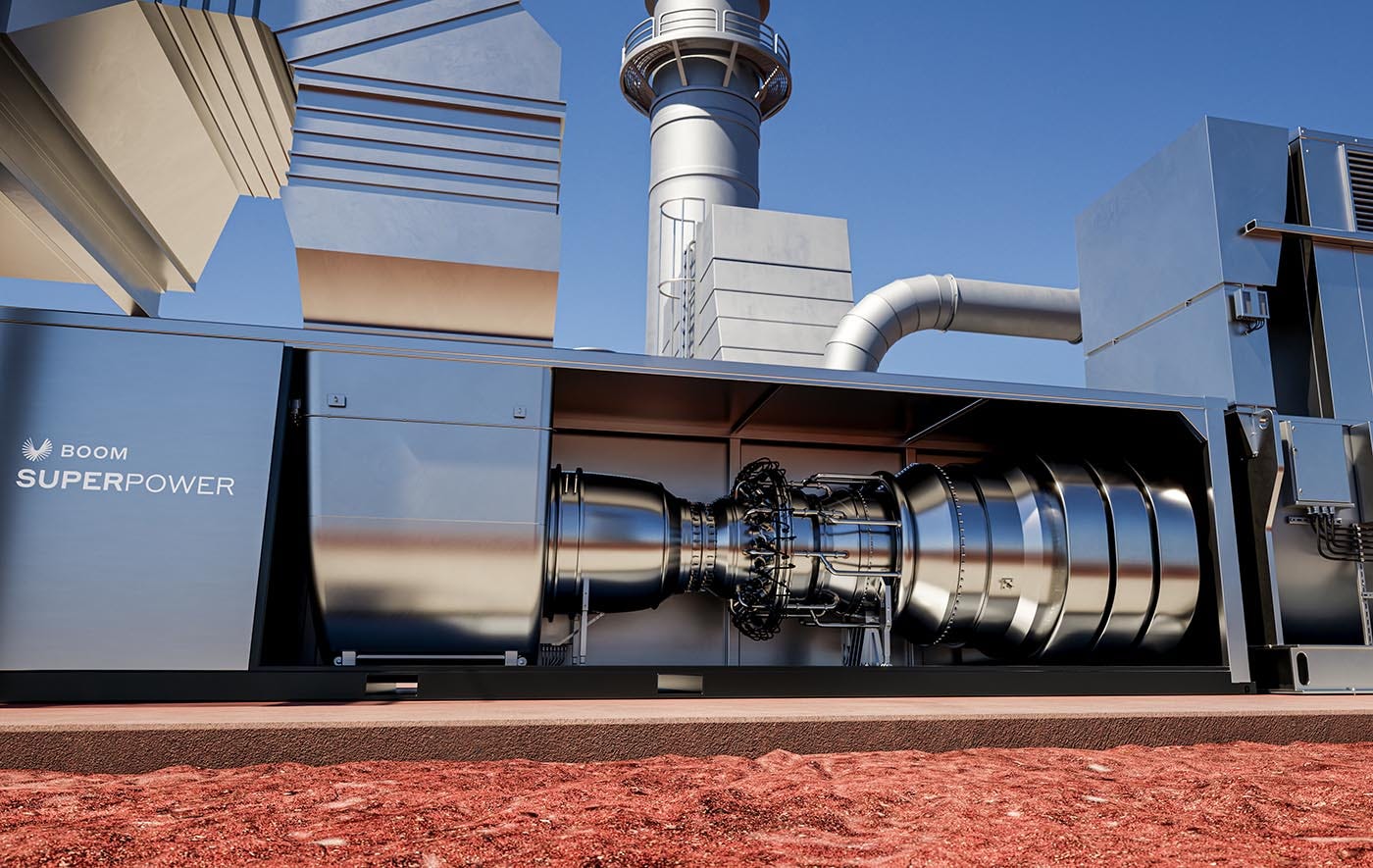
Data center developer Crusoe will be the launch customer for Boom Supersonic, which is adapting its supersonic jet engines to power data centers.
Boom unveiled its Superpower turbine yesterday, along with $300 million in funding. It also announced that Crusoe has ordered 29 of the 42-megawatt natural gas turbines, providing 1.21 gigawatts for future data center development.
Boom is an aviation company developing Overture, its vision to resume supersonic air travel. In January Boom’s XB-1 demonstration aircraft broke the sound barrier, clocking in at Mach 1.2 in a flight over Mojave, Calif. Boom says it has pre-orders for 130 Overture aircraft from customers including American Airlines, United Airlines, and Japan Airlines.
But while Overture is in development, Boom saw an opportunity to adapt its Symphony supersonic engines to provide on-site power for the data center industry, which is already using aeroderivative power infrastructure from GE Vernova and other suppliers.
Boom founder and CEO Blake Scholl says Superpower will enable gigawatts of new capacity for AI while providing revenue and engine reliability data to advance the development of Overture.
“Supersonic technology is an accelerant - of course for faster flight, but now for artificial intelligence as well,” said Schol. “With this financing and our first order for Superpower, Boom is funded to deliver both our engine and our airliner.”
Crusoe: Growth Through Energy Innovation
The announcement is the latest sign of how the AI boom is attracting new players and big investment to support the data center sector.
Crusoe is a prime example of that trend. As the developer of the Stargate campus in Abilene, Texas, it has now deployed nearly a million square feet of capacity for Oracle and its customer OpenAI.
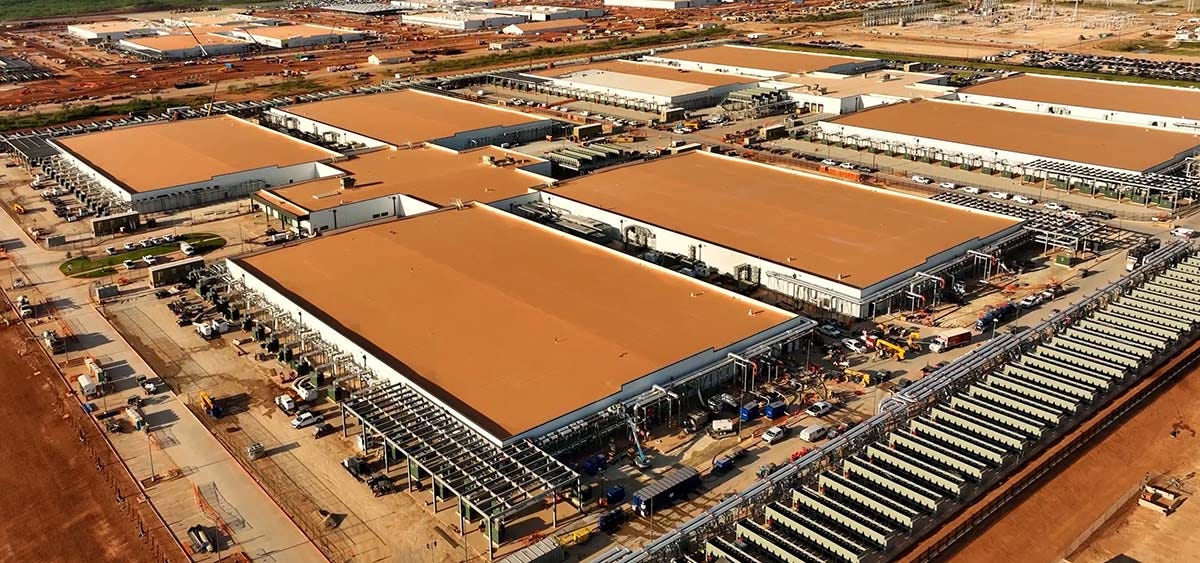
Crusoe has big plans for future MegaCampuses, and its $1.25 billion order with Boom Supersonic is a big bet on energy innovation to help deploy data centers at the speed of AI.
“Boom’s innovative approach to power turbine technology builds on the company’s impressive breakthroughs in supersonic flight,” said Chase Lochmiller, co-founder and CEO of Crusoe. “At Crusoe we are continuously searching for new approaches to increase real-world performance and accelerate time-to-power across our portfolio of energy assets and operations.
“We’re proud to be partnering closely with Boom as the launch customer for Superpower, an initiative that aligns perfectly with Crusoe’s energy-first approach to building the AI infrastructure of the future.”
Crusoe has been following the power from its inception, seeking to align the future of computing and the future of the climate.
The company started out operating mobile modular data centers deployed at oil and gas fields to tap flared gas, using the captured methane to power bitcoin mining rigs. It shifted its focus to HPC in 2022, and chose Abilene for data center development because of the region’s surplus of energy, including renewable energy.
The Boom deal is the latest in a series of investments in innovative energy strategies. Others include:
Crusoe is teaming with Redwood Materials on an energy solution featuring recycled lithium-ion batteries from EVs. Redwood said it has deployed North America’s largest microgrid to support a deployment of a new Crusoe modular data center design.
Crusoe is also partnering with Blue Energy to develop a project in Port of Victoria, Texas that the companies expect to be the industry’s first gas-to-nuclear conversion for a data center project. Blue Energy will use natural gas to bring the campus online, and then bridge to an advanced nuclear power plant of up to 1.5 gigawatts (GW) on an adjacent site.
The company is partnering with energy company Tallgrass to develop a 1.8 gigawatt data center in Laramie County, Wyoming where plans include the use of carbon capture and sequestration.
An Opportunity for Boom Supersonic
The appetite for data center capacity for the world’s largest hyperscalers (Google, Microsoft, Meta and Amazon Web Services) and AI specialists (led by OpenAI and Anthropic) caught the attention of Boom CEO Blake Scholl, who outlined Superpower’s path to market in a blog post.
“The U.S. is in a genuine energy crunch,” said Scholl. “GPU racks are idling because they can’t get power. Data centers are fighting over substations and interconnection queues. Meanwhile China is adding power capacity at a wartime pace—coal, gas, nuclear, everything—while America struggles to get a single transmission line permitted.
AI won’t wait for us to fix the grid. And the United States simply doesn’t have 10–15 years to build out power infrastructure the old way.”
Boom believes its design has advantages over existing turbines:
42 MW of ISO-rated power in a shipping-container-scale package
Full rated output in ambient temperatures exceeding 110°F
Waterless operation, enabling deployment in hot and arid environments
Runs on natural gas with backup diesel capability
Boom’s total turbine production is planned to ramp to over four gigawatts annually by 2030.
The $300 million Series B funding round, led by Darsana Capital, fully funds Symphony engine development, and ongoing revenues from the Superpower business will finance certification and delivery of Overture.
“Darsana looks forward to partnering with Boom to help develop state-of-the-art energy generation to power America’s AI revolution, all at supersonic speeds,” said Steve Friedman, Partner at Darsana Capital. “Their focus on first delivering supersonic technology to create a high-performance power turbine business reflects a smart, capital-efficient path to building the next great American industrial company.”
Can they run on methanol?
Wow!