

Tech Titans Outline Their Vision for 800 VDC
NVIDIA, Google, Microsoft and OCP Share New Spec for Solid-State Transformers

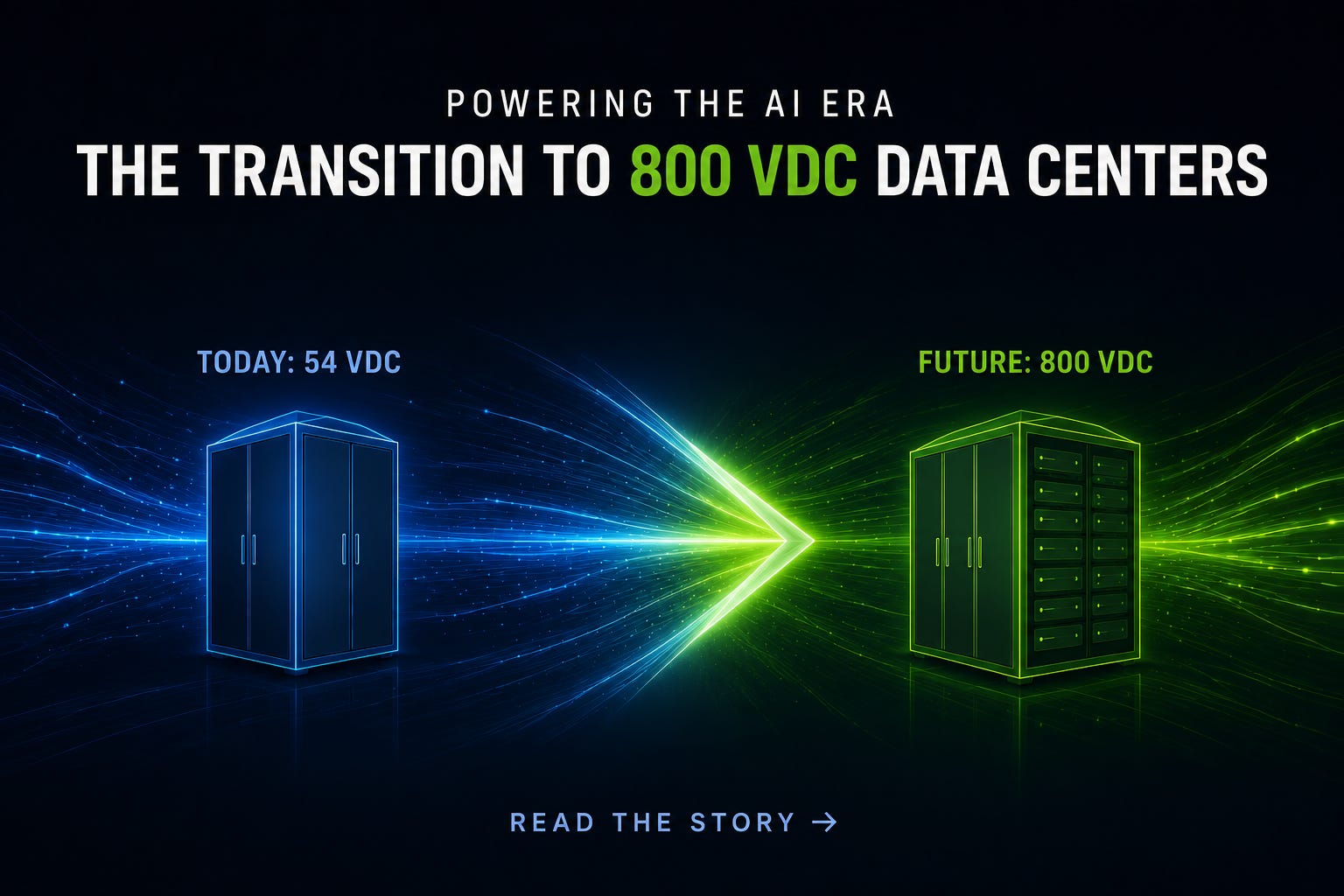
The leading tech companies have a bold vision for the future AI infrastructure. But it requires more power than today’s data centers are designed to handle.
The solution is a gradual shift to using 800 volt DC power distribution in AI data centers. It’s a major undertaking that requires upgrades of the most mission-critical components, as well as the cooperation of an entire ecosystem of vendors.
NVIDIA, Google and Microsoft have teamed with the Open Compute Project (OCP) to provide an update on the 800 VDC transition. At the OCP APAC Summit in Taipei, the companies said they will work together to create an “open, standardized power architecture for next-generation AI data centers and to make sure the entire industry can adopt it safely, at scale.”
In a key step, the companies shared the Solid-State Transformer (SST) Specification v0.3 developed through collaboration among Microsoft, Google, NVIDIA, and the broader ecosystem. The SST is emerging as a critical piece of the transition to 800 VDC power distribution, a simplified pathway from grid to rack.
The end goal isn’t a single design, but a common set of interfaces and system requirements that lets suppliers build interoperable products. The collaboration was detailed in a joint blog post by the three companies:
We are aligning on system-level performance requirements, including power quality and power smoothing standards, and end-to-end system interfaces. We are publishing these requirements openly so that equipment manufacturers can develop interoperable products with confidence, without having to navigate conflicting proprietary specifications from different customers. We are engaging in parallel with UL Solutions, NFPA, IEEE, and IEC to advance the safety certifications and regulatory frameworks that are prerequisites for global deployment.
Addressing Power and Density Constraints
Today’s racks in AI factories rely on 54 VDC power distribution, where bulky copper busbars shuttle electricity from rack-mounted power shelves to compute trays. As racks exceed 200 kilowatts, this approach begins to hit physical limits, facing limitations in copper volume, thermal loss, and space efficiency.
That moment is already on the roadmap. The shift to 800 VDC is expected to get underway in earnest with NVIDIA’s Vera Rubin Ultra GPU platform, which is expected to arrive in 2027 and support power densities of up to 600 kilowatts per rack.
Moving to 800 VDC infrastructure from traditional 415 or 480 VAC three-phase systems enables higher densities, as well as a 5 percent improvement in power efficiency, and cooling benefits as power infrastructure is moved outside the rack.
“800 VDC unlocks the compute performance and power density required for AI at scale,” said Vladimir Troy, vice president of data center infrastructure at NVIDIA. “Through OCP, NVIDIA is working with more than 80 ecosystem companies to give AI factories a practical path forward — not just a future vision.”
New Architectures Emerge
The Open Compute Project has been the data center industry’s leading venture for collaboration between hyperscale operators. OCP has called on its members to raise their game to confront how AI is disrupting digital infrastructure, driving change in data center power, cooling and networking.
“Common 800 VDC interfaces can help the industry scale AI infrastructure while protecting the flexibility operators need in real deployments,” said Tom Garvens, Vice President of Data Center Technology and Systems, Google. “By working through OCP, we can align requirements early, reduce fragmentation and give suppliers a clearer path to build interoperable products.”
Hyperscalers have also been working on the transition to higher voltages. Microsoft, Meta and Google have collaborated on Mt Diablo, an OCP design for a “sidecar” that will shift power conversion into a separate rack, laying the groundwork for denser and more configurable server racks.
Power sidecars will serve as the entry point into the 800 VDC transition. But the companies emphasized that 800 VDC isn’t a replacement for existing AC infrastructure, but an additional deployment option that can coexist with existing AC systems and enables a gradual transition as AI power density continues to increase.
