

How Solid-State Transformers Simplify Power Distribution
DG Matrix CEO Haroon Inam Outlines the Potential of Multiport SSTs for Data Centers

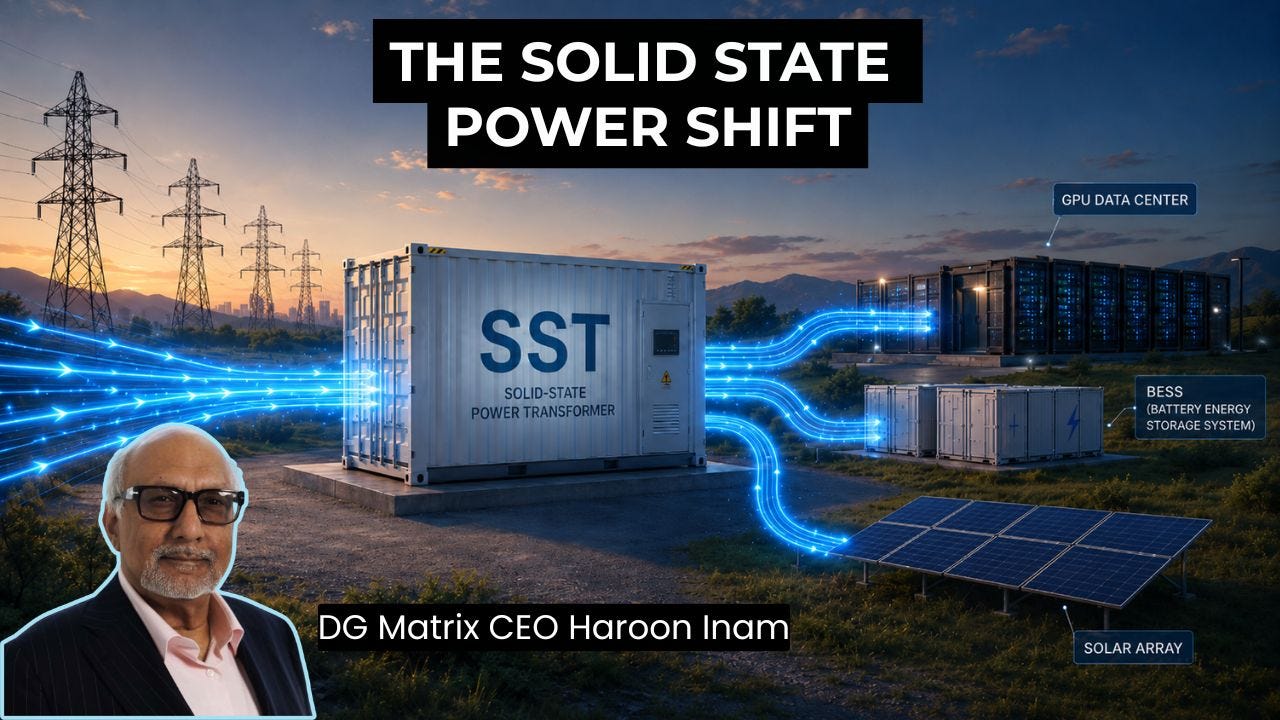
The transformer is a key component of power delivery, but its core design dates to the 19th century. A number of startups are working to build a better transformer using software-defined power electronics that are ready for the AI era.
DG Matrix is focused on solid-state transformers, which are emerging as a critical piece of infrastructure for next-generation AI data centers. Today DG Matrix CEO and cofounder Haroon Inam joins us to discuss solid-state transformers, and how a multi-port design can provide new options for savings and efficiency in the data center power chain, enabling operators to connect AC and DC devices as well as support power feeds from on-site energy sources as well as the grid.
Here's my conversation with Haroon Inam:
Here’s an excerpt from the Data Center Richness podcast with Haroon InamJoe Kava, where we discuss the challenges in building at gigawatt scale, and whether the data center sector can adapt to the wave of community resistance to AI development.
Rich Miller, Data Center Richness: You’ve mentioned the importance of a multi-port approach for solid-state transformers. What are the advantages of the multiport approach? What are the some examples of ways that can be useful?
Haroon Inam, DG Matrix: A transformer is basically a chunk of iron laminations with copper or aluminum wound around it. It works because of Faraday’s law … the rate of change of flux in a magnetic material induces power in the other windings, and that’s the workhorse for the industry with just aluminum or copper and iron.
A solid state transformer is very different. That iron is replaced by a special magnetic material that is coupled with electronic circuitry - hence the solid state portion - where the transformer becomes much, much smaller because the frequencies that interact with the transformer are much higher frequencies. And that reduces the burden on the magnetic material, and it comes way down in size. You’re merging solid state electronics with that transformer.
What we have found is that if you try to take a solid state transformer and replace the AC to AC function, it’s a dumb way to go after it. You’ve added complexity. You’ve added a lot of cost. You’ve added less reliability. And I don’t think there’s much market for an SST where you’re doing AC to AC replacement.
However, if you look at doing AC to DC conversion and dropping the voltage or adding more functionality, that’s where the balance of plant cost comes down. The reliability can go up, and, and there’s an economic benefit. So the additional power conversion adds value.
And then taking that further, there’s more functionality you can add by aggregating multiple sources into a solid state transformer. You can’t do that with a regular transformer, but you can do it with a solid state transformer and specialized controls. Then the value goes way up, because now you’ve got what is called a multiport solid state transformer with multiple DC and AC ports. And you can combine solar energy and fuel cells, which are predominantly DC. You can combine natural gas turbine outputs. You can combine grid power. And you can do it almost in any ratio and sequence you want in fractions of a second, and you can feed multiple loads simultaneously, AC or DC.
That’s the magic of multiport SSTs, and the economic value is huge because you’ve collapsed everything. You’ve collapsed the energy management system, and you’re also able to supply both AC and DC power simultaneously, de-risking future data center 800 volt or AC adoption. You don’t have to guess. You can do both. And you’ve also collapsed the energy management system into a very fast software-driven power fabric that can aggregate and route power in any way you want. I think that’s the advantage that a multiport SST brings to the market.
Rich Miller, Data Center Richness: You mentioned the software component. We’re going from the old hardware that you discussed to using semiconductors and software and effectively creating a programmable option where you didn’t really have that before.
Haroon Inam, DG Matrix: Correct. I think a lot of folks have been doing firmware and controls using digital signal processors, DSPs, microprocessors, CPUs, but they seem to run down to a limit of a few microseconds. It’s tough for these devices to go below a few microseconds of, of computational time and lag. So if you really want to get down into having a true firmware and, and software-controlled converter, you’ve got to get into the nanosecond range in programmability.
So we offer that capability, that from tens of nanoseconds to microseconds to milliseconds to seconds. The whole stack is tightly integrated, and that allows you to make it extremely programmable. The same machine can be a car charger, or it can be a 800 volt DC architecture to power your data center. The advantage of that is that you make one machine, and you keep duplicating it over and over again. You make the same spare parts, you make it with a consolidated supply chain, you make it with a trained workforce, you make it with the same quality principles, and you deploy in multiple markets. So we’re big believers in that software programmability down to the billionths of seconds.
Rich Miller, Data Center Richness: You mentioned the multiport creates the opportunity to use a number of different power sources. In the data center sector, there’s been a lot of interest in microgrids, that can do that type of thing. Are you an alternative to microgrids, or could your equipment could be used in microgrids?
Haroon Inam, DG Matrix: Excellent question. I think the simple answer is that we make microgrids far more economical. People have been combining multiple sources in microgrids for years. The problem is not the combination of sources, which yields the lowest levelized cost of energy. The problem is all the electronics, the inverters, the rectifiers, the isolation transformers, the protection gear that it takes to do that job. And what a multiport (SST) does is collapse all the electronics in a microgrid into a unified block, and it makes it more economically viable, and it increases the speed to compute.
This text companion accompanies the video “What Solid-State Transformers Mean for Data Centers” with Haroon Inam, CEO of DG Matrix. Watch on our YouTube channel for the full conversation and additional context.
Learn More About SST
If you’re interested in solid-state transformers, here are two additional resources to learn more:

